1 min read
How To Do Effective Project Estimating
.jpg?width=30&name=Dan%20Pic%20(1).jpg) Dan LeBel : Apr 13, 2023, 10:15:00 AM
Dan LeBel : Apr 13, 2023, 10:15:00 AM
A step-by-step process and model-driven approach for creating a project estimate: imagining a report development project for a product-based company.
4 min read

Copilot Studio agents are gaining broader visibility and adoption and are moving from experimentation to real production workloads. The challenge most organizations run into isn't standing up the first agent. It's what happens when the second one arrives, or when a compliance officer asks, "what exactly is this thing allowed to say?"
That's where early momentum turns into friction. One team wants speed, another needs controls. Leadership wants adoption but also needs confidence that responses are grounded, auditable, and aligned to policy. In our experience, the organizations that navigate this well treat governance as a layered system of technical and operational controls, not a document someone wrote before go-live.
Most governance gaps aren't caused by bad intent. They're caused by inconsistent delivery patterns: agents built by different teams with different instruction styles, knowledge scope that's broader than intended, ad hoc changes with no approval workflow, and fuzzy ownership once the first release ships.
For organizations already on Microsoft 365, these gaps are avoidable. The underlying control plane exists. The challenge is standardizing how teams use it.
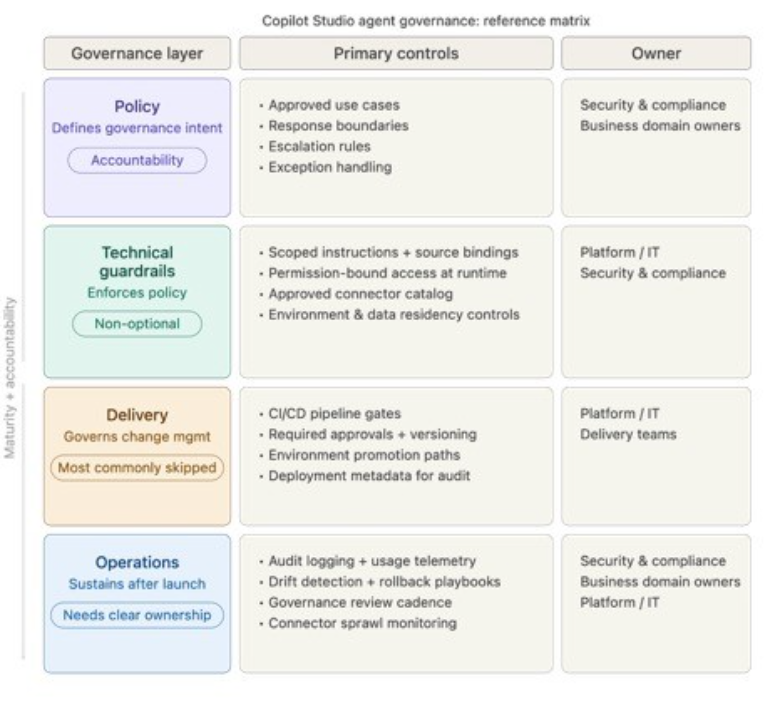
A practical model has four layers, each with clear owners and testable controls. The layers define accountability and governance intent, while the control points translate those requirements into enforceable technical, security, and operational controls.
The matrix below maps each layer to its primary controls and ownership and provides the foundation for everything that follows.
Manifest controls define the behavior contract: agent purpose, instruction boundaries, source inclusions and exclusions, and default handling for out-of-scope requests. The pattern that holds up most consistently in Copilot Studio deployments is scoped instructions, bounded sources, and explicit "do not speculate" behavior. Agents that skip any one of these tend to generate the incidents that slow broader adoption.
Access controls should inherit enterprise identity models wherever possible. Agent visibility follows existing site and team access. Author, approver, and deploy roles are separated for higher-impact agents. This reduces custom security logic and keeps governance aligned with how Microsoft 365 already operates.
Connector and environment controls are foundational and they're the area most organizations underestimate until something goes wrong. Every connector an agent uses effectively extends its trust boundary. An agent that looks well-scoped on paper can expose sensitive data or reach systems it was never intended to touch if connector and environment governance aren't treated as first-class requirements.
An agent's risk profile is determined by both its knowledge sources and its action surface. Governing one without the other leaves half the exposure unaddressed.
In practice, this means defining approved connector catalogs, enforcing Data Loss Prevention (DLP) policies, restricting high-risk external connectors, and establishing environment strategies that enforce clean separation between development, testing, and production workloads. Agent deployment should be limited to sanctioned environments with clearly defined data residency, compliance, and ownership requirements.
When these controls aren't in place, the consequences are usually quiet: an agent deployed in a test environment that was never properly promoted, a connector approved for one use case silently enabling another, or a data boundary crossed because no one mapped the access path end to end. Connector sprawl is a governance failure; it just doesn't announce itself the way an outage does.
As agent portfolios grow, governing access paths becomes just as important as governing responses. Teams that treat connectors as mere configuration choices rather than governed dependencies will find themselves managing incidents instead of maturity.
Pipeline controls put release governance into automated workflows: schema validation before packaging, promotion blocked when checks fail, deployment metadata captured for audit, rollback enabled to known good versions. Teams move faster when control checks are consistent and repeatable; the friction is front-loaded, not scattered across production incidents.
A policy document can say "keep responses grounded." A delivery system enforces grounding through source scoping and instruction standards. A policy document can say "changes require approval." A pipeline blocks release until that approval exists.
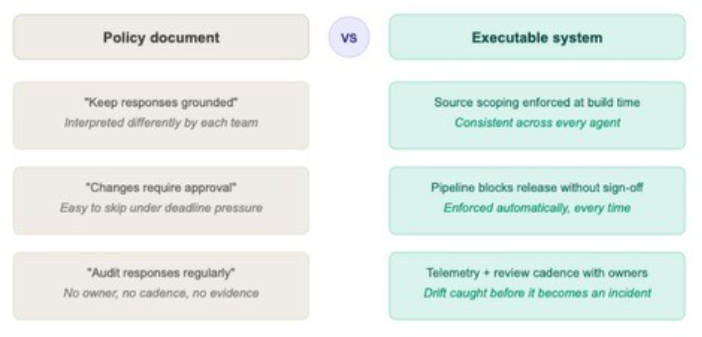
The difference matters because documents don't prevent drift; they just describe the intent. When governance is executable, teams know exactly what's required to ship, review overhead drops because controls are standardized, and risk posture improves without creating a bottleneck.
Governance frameworks fail when ownership is vague. A practical model assigns it clearly:
The goal is a shared model where each group knows how their responsibilities show up in day-to-day work, not just on a RACI chart.
If you're formalizing a governance model now, start here:
The checklist below sequences these six actions by phase, with the connector audit flagged as the step most commonly deferred.
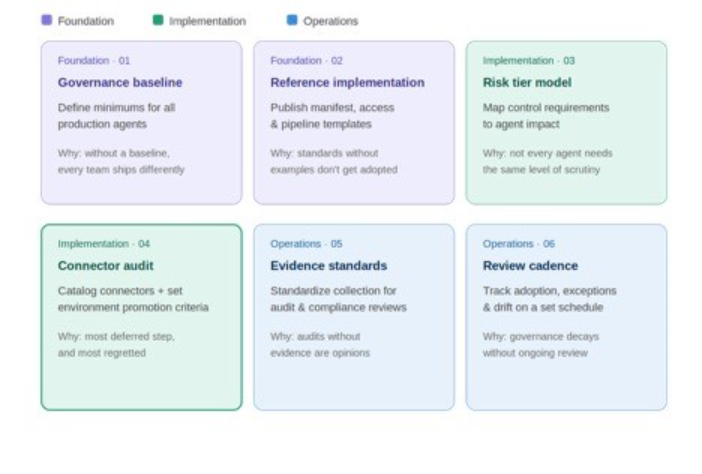
You don't need perfect standards on day one. Start with enforceable minimums and evolve from there.
Most organizations don't need another governance framework. They need a practical way to operationalize the controls they already know they should have. That's where governance efforts typically stall.
Spyglass helps clients translate governance requirements into repeatable implementation patterns for Copilot Studio, including governance baselines, environment and connector strategies, deployment controls, and operational playbooks. Our focus isn't just getting agents into production. It's helping organizations build a scalable governance model that supports adoption, reduces risk, and stands up to real-world operational and compliance demands.

1 min read
Dan LeBel : Apr 13, 2023, 10:15:00 AM
A step-by-step process and model-driven approach for creating a project estimate: imagining a report development project for a product-based company.

1 min read
Modern DevOps workflows increasingly rely on secure, automated authentication between CI/CD pipelines and cloud providers. GitHub’s OpenID Connect...
.png)
1 min read
 Ian Dicker : Mar 7, 2022, 9:45:00 AM
If you want to build an application that is externally focused, for example, a customer data gathering application, vendor management system, or to...